
Abstract
Rhizosphere and endophytic microorganisms may contribute to secondary metabolism in medicinal plants, influencing both metabolite diversity and accumulation. By producing bioactive compounds and signaling molecules, these microbes may influence plant metabolic pathways beyond simple nutrient supply. In this review, we summarize recent advances in understanding how microbial secondary metabolites regulate may affect biosynthetic processes in medicinal plants through integrated signaling, metabolic, and genomic mechanisms. These studies suggest that microbial-derived elicitors trigger early signaling events, including reactive oxygen species production, calcium fluxes, and mitogen-activated protein kinase cascades, which are further integrated with phytohormone networks, such as jasmonic acid, salicylic acid, ethylene, and auxin. This coordinated signaling may contribute to transcriptional reprogramming mediated by key transcription factors, ultimately enhancing the biosynthesis of alkaloids, terpenoids, flavonoids, and phenolic compounds. We also highlight the distinct contributions of major microbial groups, including arbuscular mycorrhizal fungi, plant growth-promoting rhizobacteria, and endophytes, each of which may influence plant metabolism through complementary mechanisms such as nutrient acquisition, hormonal modulation, and direct biosynthesis of bioactive compounds. In addition, we discuss recent progress in microbial genomics, which has revealed the importance of biosynthetic gene clusters (BGCs), hormone-related genes, and volatile compound pathways in shaping medicinal plant-microbe metabolic interactions. These genomic features indicate microbial functional potential and may underpin stable colonization and metabolic regulation under appropriate biological conditions. Finally, we outline current challenges, including limited integration of multi-omics data and insufficient resolution of spatial and temporal dynamics in plant-microbe interactions. We suggest future directions focusing on the integration of spatial metabolomics, genome mining, and synthetic microbial communities to improve mechanistic understanding and enable more precise manipulation of medicinal plant metabolism.
1. Introduction
Medicinal plants are plant species capable of producing metabolites with therapeutic or health-promoting effects. These metabolites include alkaloids, terpenoid compounds, flavonoids, and cannabinoids. The medicinal value of these plants depends not only on biomass production but also on the concentration, composition, stability, and bioactivity of their secondary metabolites [1]. Therefore, improving medicinal plant production requires attention to both plant growth and phytochemical quality. Medicinal plants represent a critical source of bioactive compounds for both traditional medicine and modern pharmacology, contributing significantly to global healthcare systems [2,3]. Approximately 80% of the global population relies on plant-derived medicines for primary healthcare, highlighting their continued importance in contemporary therapeutics [2]. Because their therapeutic efficacy is closely linked to the accumulation of bioactive secondary metabolites, understanding the biological and environmental factors that regulate metabolite biosynthesis is essential for improving medicinal plant quality [3,4].
However, increasing global demand for natural medicinal products has intensified pressure on wild plant resources, leading to overexploitation, habitat degradation, and loss of biodiversity [5,6]. Although artificial cultivation has been widely adopted to alleviate these pressures, cultivated medicinal plants often exhibit reduced bioactive compound content, longer growth cycles, and yield instability, particularly under continuous cropping systems [5,7,8]. These limitations highlight the urgent need for innovative and sustainable strategies to enhance both yield and phytochemical quality in medicinal plant production systems [6].
In this context, the plant microbiome has emerged as a key determinant of plant health and metabolic function, shifting research paradigms toward the holobiont concept, where plants and their associated microorganisms are considered an integrated biological unit [9,10]. Within these microenvironments, rhizosphere microorganisms secrete diverse secondary metabolites and play indispensable roles in promoting host growth, improving nutrient acquisition, enhancing stress resistance, and regulating the accumulation of pharmacologically active compounds [11,12]. Beneficial microbial groups, including plant growth-promoting rhizobacteria (PGPR), arbuscular mycorrhizal fungi (AMF), and endophytes, establish mutualistic interactions with host plants through chemical signaling and nutrient exchange [13,14].
Microorganisms regulate plant secondary metabolism through complex signaling mechanisms initiated by microbial-derived elicitors. These elicitors may be recognized by plant receptors and can initiate or modulate signaling responses involving reactive oxygen species, phytohormones, and transcriptional reprogramming, which may subsequently influence biosynthetic pathways in a context-dependent manner [15,16]. Empirical studies have reported microbial effects on key medicinal compounds, such as glycyrrhizic acid in Glycyrrhiza uralensis, cannabinoids in Cannabis sativa, and hypericin in Hypericum perforatum [[17], [18], [19]]. These findings indicate that microbial secondary metabolites function not only as antimicrobial agents but also as signaling molecules that actively regulate plant metabolic pathways [4,20]. However, these examples differ in evidential strength. Some provide direct inoculation evidence with metabolite quantification, whereas others are supported by transcriptomic changes, microbial community shifts, or microbiome–metabolite associations. Therefore, these cases should be interpreted as evidence for potential microbial contributions to medicinal metabolite regulation, rather than as uniformly equivalent demonstrations of causal regulation.
Recent advances in multi-omics technologies have significantly improved our understanding of plant–microbe interactions at molecular and ecological levels [10,21]. Integrated approaches combining genomics, transcriptomics, and metabolomics enable the identification of microbial biosynthetic genes, signaling networks, and rhizosphere metabolic landscapes [22,23]. These tools provide new insights into how microbial communities influence plant metabolism.
To ensure a comprehensive and objective synthesis of the interactions between medicinal plants and the rhizosphere microbiome, a structured literature search was conducted across multiple scientific databases, including Web of Science, Scopus, and PubMed. The search encompassed publications primarily from 2000 to 2026, with a strategic emphasis on recent high-impact advances published between 2015 and 2026. Search queries were constructed using combinations of the following keywords: “medicinal plants”, “rhizosphere microbiome”, “secondary metabolites”, “microbial elicitors”, and “biosynthetic gene clusters”. Both original research articles and review articles were considered. However, experimental studies that included direct measurements of medicinally relevant metabolites, such as alkaloids, terpenoids, flavonoids, phenolic compounds, glycosides, cannabinoids, or other bioactive compounds, were prioritized. Selected articles were required to provide mechanistic insights into microbial-mediated metabolic regulation, signaling transduction, metabolite accumulation, or multi-omic integration within medicinal plant systems. To maintain the thematic integrity of this review, studies were excluded when they focused only on general plant growth, biomass promotion, or rhizosphere community shifts without a direct connection to medicinal compounds, secondary metabolite pathways, or phytochemical quality. Therefore, this review should be regarded as a selective narrative review based on a structured literature search rather than a formal systematic review.
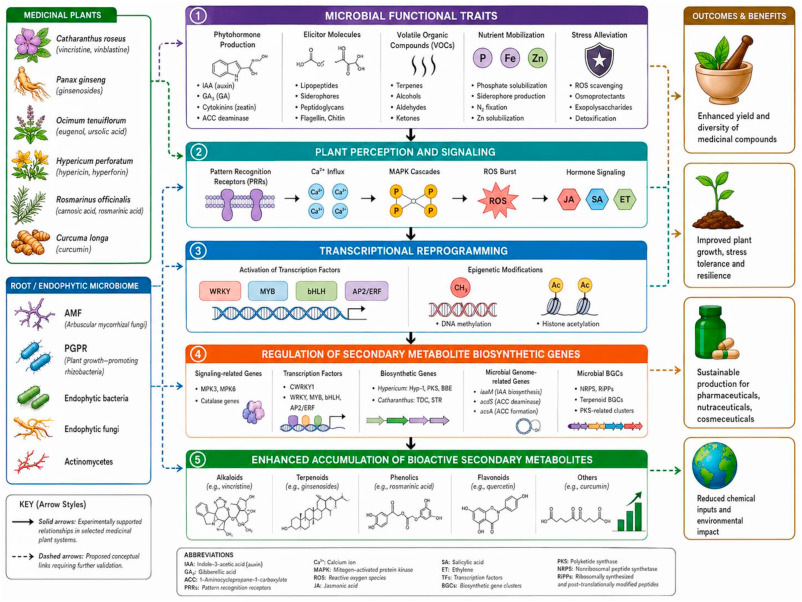
In this review, we focus on medicinal plants from different host systems and evaluate how rhizospheric and endophytic microorganisms promote the biosynthesis of pharmacologically active metabolites. This review summarizes (i) the molecular mechanisms by which microbial signals regulate secondary metabolism in medicinal plants, (ii) compares the unique contributions of arbuscular mycorrhizal fungi (AMF), plant growth-promoting rhizobacteria (PGPR), and endophytes to metabolite enhancement, (iii) links microbial genomic characteristics with plant signaling and metabolic outcomes, and (iv) discusses how these findings may improve product quality in the future (Fig. 1, Fig. 2).


發表留言